Debian Turns 33: Where It All Started for Me
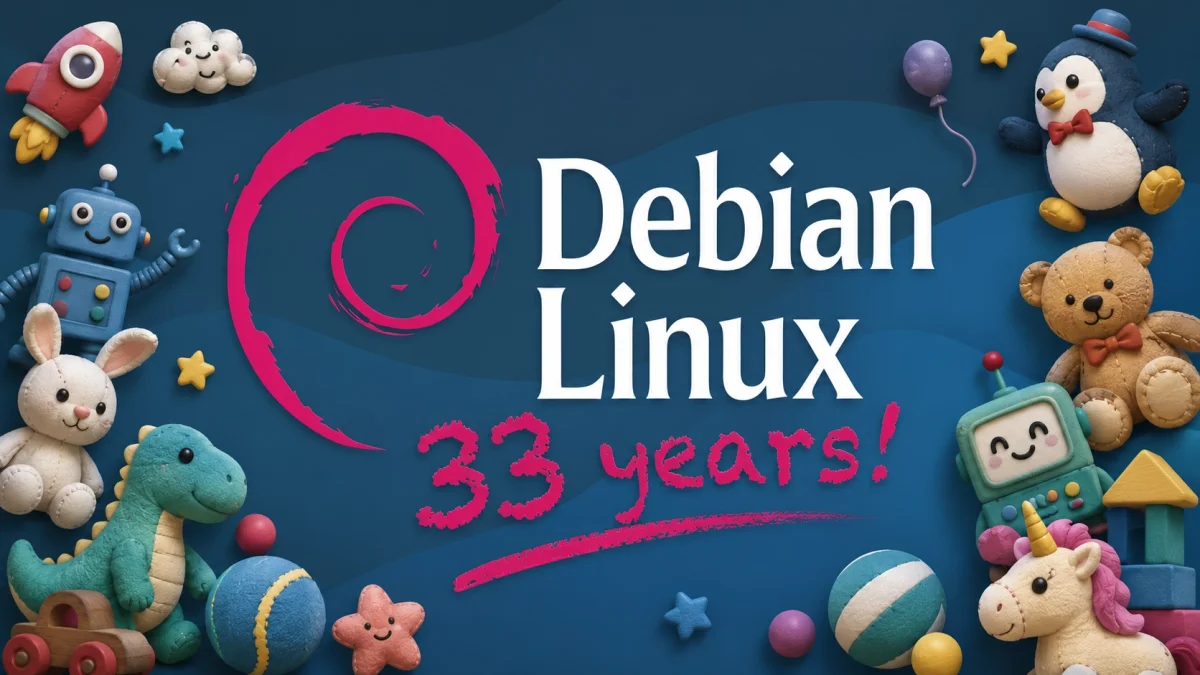
Debian Turns 33!
On August 16, 1993, Ian Murdock announced a new Linux distribution to the world. Thirty-three years later, Debian is still here.
For me, though, Debian isn't just a Linux distribution celebrating another birthday. It's part of my own history with computers.
I was about 14/15 years old, I had a computer that was nothing special, and I was incredibly curious.
At the time, I was part of an amateur radio club in Güímar, Tenerife. That's where I started learning about ham radio and electronics, but also about GNU/Linux and everything a computer could become once you started looking beyond the software that came preinstalled on it.
That's where Debian entered my life.
And with it, an entire world opened up.
A modest computer with almost no limits
It's hard to recreate that feeling for someone discovering Linux today.
The Internet was very different. Connections were slow, documentation wasn't nearly as accessible as it is now, and getting Linux installed could require a fair amount of patience. You had to search, read, understand error messages, and sometimes start over from scratch.
But that was part of what made it so fascinating.
With Debian, my old PC became a machine I could experiment with almost endlessly.
I started discovering programming, servers, networking, system administration, security, Unix permissions, services, logs, packages, scripts, and the command line.
More importantly, I learned something that has stayed with me ever since: don't be afraid to experiment.
Install something. Break it. Figure out why it broke. Fix it. Try again a different way.
That way of learning has probably been just as valuable to me as many of the technologies I've learned since.
Debian also introduced me to free and open source software
At 15, I obviously wasn't thinking about open source governance or software business models.
What I saw was much simpler: thousands of programs were suddenly available to anyone.
You could install them, use them, read the documentation, look at the source code, modify them, and learn from other people's work.
And behind all of that were communities.
Forums, mailing lists, developers, sysadmins, and enthusiasts sharing what they knew over the Internet.
For a lot of people in my generation, Linux was a gateway into that world. And Debian was often one of the first distributions that handed us the keys.
That philosophy didn't happen by accident. Since 1997, Debian has had a Social Contract defining its commitments to users and the free software community. The Debian Free Software Guidelines also became the basis for what would later become the Open Source Definition. (debian.org)
33 years without belonging to a company
Debian was officially founded by Ian Murdock on August 16, 1993. His original announcement already described the idea of building a distribution openly, in the spirit of GNU and Linux.
The project began with a small group of enthusiasts and grew into an international community of developers and volunteer contributors. Even today, Debian remains a community project rather than a distribution controlled by a corporation. (bits.debian.org)
That's probably one of the reasons Debian has survived so many generations of technology without losing its identity.
Trends have changed.
Architectures have changed.
Desktop environments have changed.
Cloud computing, containers, ARM, and RISC-V have all arrived.
But some of Debian's priorities have remained remarkably consistent: stability, security, software freedom, package quality, and community.
From Bullseye to Trixie
Debian has never been known for rushing releases. In fact, that approach has become part of its reputation.
Its recent releases show that the project is still moving forward.
Debian 11 "Bullseye" was released on August 14, 2021. It is now approaching the end of its LTS lifecycle, with support scheduled through August 31, 2026.
Debian 12 "Bookworm" arrived on June 10, 2023. One important change was the introduction of the non-free-firmware section, which made it easier for official installation images to support hardware that requires proprietary firmware.
Debian 13 "Trixie" was released on August 9, 2025. As I write this, the current stable release is Debian 13.6, released on July 11, 2026. It includes Linux kernel 6.12 LTS, PHP 8.4, Python 3.13, PostgreSQL 17, OpenJDK 21, GCC 14.2, GNOME 48, and KDE Plasma 6.3, among many other packages. Trixie also officially added 64-bit RISC-V as a supported architecture. (debian.org)
Debian 13 includes close to 70,000 packages and more than 1.46 billion lines of source code according to the project's own figures. It's hard not to think back to that little operating system I was discovering as a teenager. (debian.org)
And the next chapter is already being written.
Debian 14 "Forky" is currently the testing branch, while Debian 15 "Duke" already has its codename. No official release dates have been announced yet. (debian.org)
Debian is everywhere, even when you don't see its name
Debian's influence goes far beyond the people who install Debian GNU/Linux directly.
Ubuntu is based on Debian.
So is Kali Linux.
Tails, PureOS, and Grml are also among the Debian derivatives officially highlighted by the project. (debian.org)
Each of those distributions has gone on to build its own ecosystem, tooling, and community, but a significant amount of the work Debian does around packaging, architectures, and infrastructure continues to serve as a foundation.
That may be one of the most impressive things about Debian's impact.
It has never needed to be the most visible Linux distribution to be one of the most important.
A few Debian details I still love
Then there are all the little details that have become part of Debian's identity.
The name Debian comes from combining Debra and Ian, the names of Debra and Ian Murdock. (debian.org)
For years, Debian releases have been named after characters from Toy Story.
Buzz, Rex, Woody, Sarge, Jessie, Stretch, Buster, Bullseye, Bookworm, and Trixie all come from that universe.
And what about sid, the branch that permanently remains unstable?
In Toy Story, Sid is the kid next door who takes toys apart and mistreats them.
That's a pretty fitting name for a branch where things can occasionally break.
The tradition began during the time of Bruce Perens, a former Debian Project Leader who also worked at Pixar. (debian.org)
Debian also keeps the familiar three-branch structure that almost every longtime user knows:
stable, the recommended production release
testing, where the next stable release takes shape
unstable, permanently known as sid, where much of the latest development first arrives
It sounds simple when described that way, but behind it is a huge infrastructure for testing, dependency management, and quality control that eventually allows testing to become the next stable release. (debian.org)
Want to try Debian today?
The current stable release is Debian 13.6 "Trixie".
For most standard PCs with 64-bit Intel or AMD processors, you'll want the amd64 architecture.
Debian also provides images for ARM, POWER, RISC-V, and IBM System z. The netinst images are relatively small: they install the base system first and then download the remaining packages from the Internet. (debian.org)
64-bit Intel or AMD PCs — amd64
https://cdimage.debian.org/debian-cd/current/amd64/iso-cd/debian-13.6.0-amd64-netinst.iso
64-bit ARM systems — arm64
https://cdimage.debian.org/debian-cd/current/arm64/iso-cd/debian-13.6.0-arm64-netinst.iso
32-bit ARM — armhf
https://cdimage.debian.org/debian-cd/current/armhf/iso-cd/debian-13.6.0-armhf-netinst.iso
64-bit POWER — ppc64el
https://cdimage.debian.org/debian-cd/current/ppc64el/iso-cd/debian-13.6.0-ppc64el-netinst.iso
64-bit RISC-V — riscv64
https://cdimage.debian.org/debian-cd/current/riscv64/iso-cd/debian-13.6.0-riscv64-netinst.iso
IBM System z — s390x
https://cdimage.debian.org/debian-cd/current/s390x/iso-cd/debian-13.6.0-s390x-netinst.iso
To avoid linking to an ISO that becomes outdated after the next point release, Debian also keeps all current official images here:
https://www.debian.org/CD/http-ftp/
And if you just want to try Debian from a USB drive without installing it, Debian Live images are available with GNOME, KDE, Xfce, Cinnamon, MATE, and other desktop environments. Official Debian 13 Live images are currently available for 64-bit amd64 systems. (debian.org)
https://www.debian.org/CD/live/
33 years later
Today, of course, I've worked with countless operating systems, programming languages, frameworks, and tools.
But Debian still has a special place for me.
Because before it was an operating system, it was a place to learn.
Debian made me want to understand what was happening behind the computer instead of simply using it. To understand a network. A server. A program. A Unix system. To read documentation. To investigate an error. To try something without knowing in advance whether it would work.
And above all, to stay curious.
I think a lot of developers and sysadmins from my generation have a similar story with GNU/Linux. An old PC, an Internet connection, countless hours spent searching for answers, and that incredible feeling that you suddenly had access to an almost unlimited amount of knowledge and software.
For me, that story started with Debian.
Thirty-three years after it was created, it's still my favorite Linux distribution.
Happy birthday, Debian. And thank you for everything you've taught me.
Official sources
- Debian turns 33!
- A Brief History of Debian
- Debian Social Contract
- Debian Releases
- Debian 13 "Trixie"
- Debian derivatives
- Debian installation images
- Debian network install
Jatniel
Full-stack PHP Developer - Freelance